
Introduction
Loud, large, fast, and equipped with the best in data acquisition, the BMW XM serves as Dewesoft's ultimate demonstration platform in the USA. Wait - a BMW is an American car? In fact, the XM model is manufactured by BMW in Spartanburg, South Carolina. This plant is the BMW Group's only assembly facility in America and serves as the global competence center for all X models. This high-performance, plugin-hybrid is packed with the latest automotive technology.
Thousands of people around the world, especially in Europe, have seen the Dewesoft BMW 330e, which our colleagues at Dewesoft headquarters in Slovenia have extensively instrumented with Dewesoft DAQ instruments and sensors. Now joining the team is the all-American BMW XM, equipped with Dewesoft instrumentation. This impressive feat of engineering is Dewesoft USA’s vehicle testing demonstrator and show car.
Background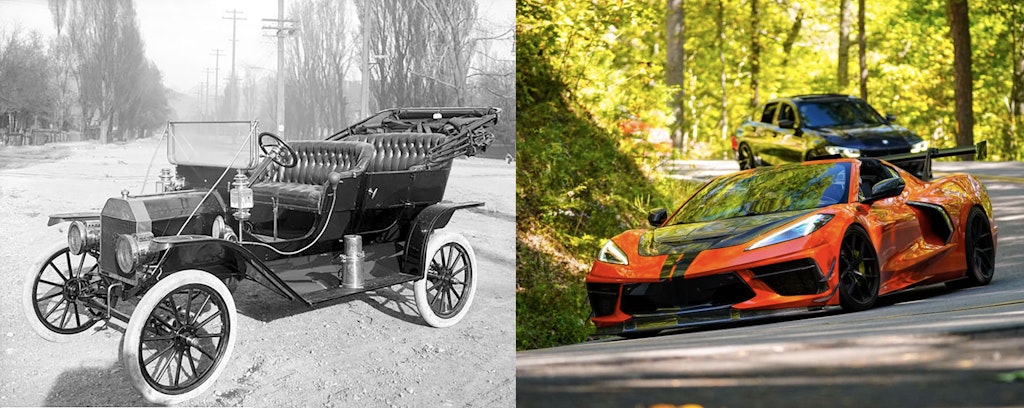
In the early days, testing cars was highly subjective. For example, engineers designed a new suspension system and built one for testing. They installed it and sent a driver onto a track to test it. They’d interview the driver afterwards to get his opinion about the ride.
Subjective measurements like that have been replaced by objective testing using modern data acquisition systems. These systems precisely record data from analog sensors of all types, digital data from encoders and data buses such as CAN, CAN FD, and others, inertial navigation systems, Global Navigation Satellite Systems such as GPS, and video cameras.
Why did we build it?
Dewesoft instruments help manufacturers design and build safer and better cars, trucks, and motorcycles. Virtually all major car, truck, and motorcycle manufacturers worldwide use Dewesoft DAQ systems, including Ford, General Motors, Mercedes, BMW, Audi, Volvo, Tesla, and many others.
We cover a wide range of vehicle testing applications, such as:
- Combustion analysis
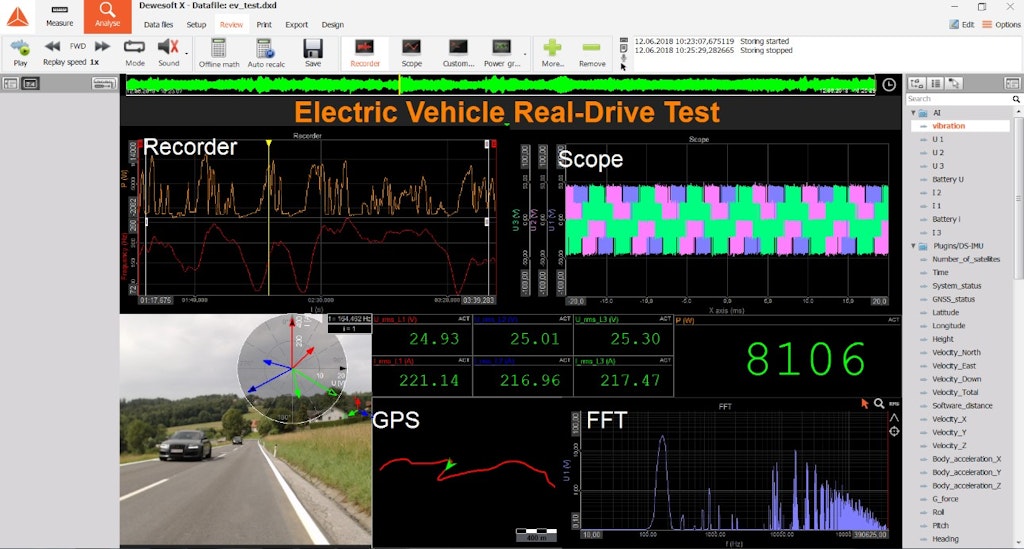
- Electrical power testing
- Acoustics and NVH
- EMC chamber testing
- ADAS testing (Advanced Driver Assistance Systems)
- Vehicle dynamics testing
- Vehicle performance testing
- Road-load data acquisition
- Durability and fatigue testing
- and many more
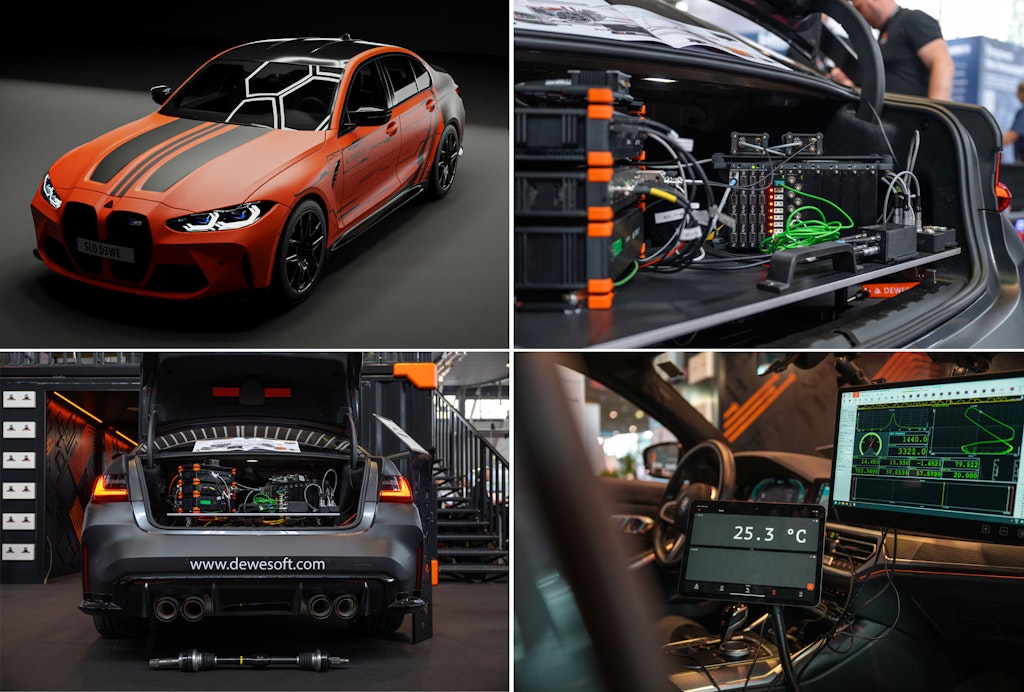
To show these capabilities, our colleagues at Dewesoft headquarters in Slovenia built a “show car” with our systems and sensors installed and working. In addition to looking impressive at trade shows, the show car allows us to demonstrate the full range of our testing capabilities to automotive engineers and technicians at their facilities and test tracks.
Read more about the development of the original Dewesoft show car:

How We Built a Cutting-Edge Vehicle Test Data Acquisition System
In an effort to demonstrate the full capabilities of our data acquisition systems, our engineers built a 'show car' equipped with advanced testing instrumentation. They selected a BMW 330e PHEV to showcase a variety of automotive testing solutions, including engine performance, noise, vibration, and harshness analysis, as well as ADAS functionality. The project involved complex installations and safety considerations, culminating in successful demonstrations at various events.
It’s too expensive to ship a show car around the world, and it’s in constant demand, so we decided to build one here in America. After a search, we selected a BMW, also known as “the ultimate driving machine.”
We wanted a hybrid vehicle to showcase our EV and HEV power analysis solutions alongside our internal combustion engine (ICE) capabilities. This led us to select the 2023 BMW XM, a gasoline-electric hybrid powerhouse with impressive specifications:
SpecificationUSInternationalWeight | 6054 lbs | 2746 kg
Length | 16.7 ft. | 5.1 m
Horsepower | 644 | 644
Acceleration | 0 to 60 MPH in 4.4 s | 0 to 96.5 KPH in 4.4 s
Planning the instrumentation
We instrumented the car from the perspective of a car company conducting benchmarking tests on pre-production vehicles. Accordingly, everything is designed to be easily installed and removed while providing the maximum amount of data. Several key data points were deemed most important:
- Acceleration
- Braking
- Handling Performance
- Engine Performance
- Interior Sound
- Exterior Sound (especially exhaust noise)
- Passenger Comfort
After determining the data points we wanted to collect, the next step was to determine the most effective way to collect the data.
Acceleration, braking, and handling performance
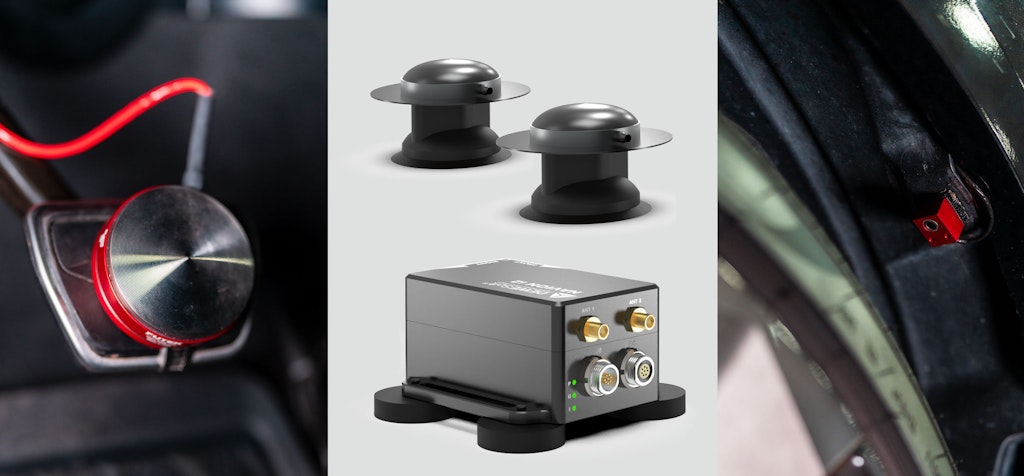
The Navion i2 is designed for the most challenging environments. It is sealed against liquid and dust in conformance with IP67. It withstands shocks of up to 75 g and is rated to MIL-STD-810G, operating across a wide temperature range of -40 °C to 85 °C.
Find out more about the Navion i2 inertial navigation system.

NAVION®
Inertial navigation systems (INS)
In addition to the INS/IMU, we installed a Futek brake-pedal load cell to measure the braking force required at any given time. This data is correlated with IMU data to determine the braking force necessary to achieve a desired acceleration, thereby assessing the braking system's effectiveness.
Third, we track tire performance using two contact-free infrared temperature sensors mounted in the wheel wells to measure tire surface temperature. This is a crucial aspect in a performance car, especially at the limits. These temperature sensors are connected to a SIRIUS 8xSTG, a versatile module that measures everything from simple voltage to differential signals, as well as load cells and strain gauges.
Braking and acceleration performance are calculated using our Brake Test plugin, which can calculate braking or acceleration times, distances, and rates.
Engine performance
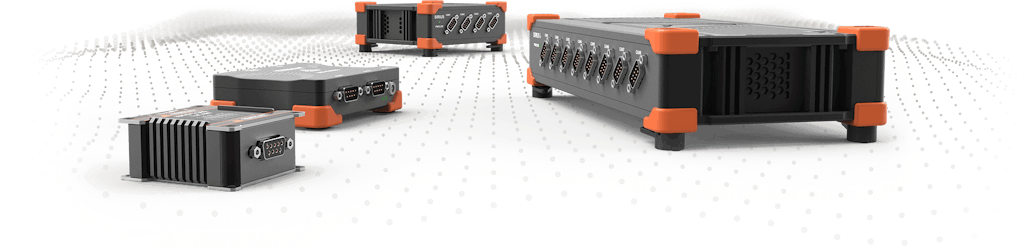
The ICE powertrain’s performance is monitored using a series of thermocouples to measure intake and engine bay temperatures, as well as radiator performance. These are connected to a KRYPTON 16xTH, a highly rugged thermocouple module that can withstand extreme temperatures and is hermetically sealed to IP67. 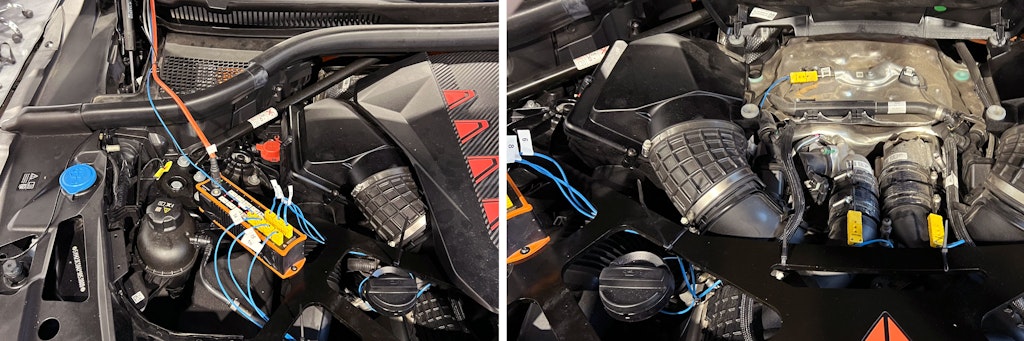
Learn about Dewesoft CAN interfaces.

CAN Bus Interfaces
USB and EtherCAT CAN bus analyzers
Interior and exterior sound
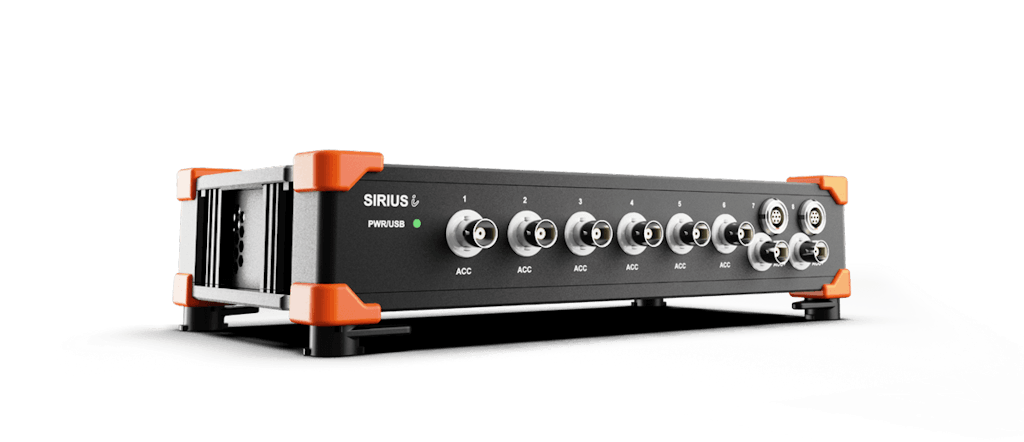
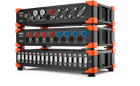
Interior and exterior sound are measured using a SIRIUS 8xACC module. This module provides constant-current excitation to two PCB® IEPE microphones, strategically placed on the vehicle, to measure interior noise and the exhaust note.
Using our Sound Level Meter and Advanced FFT analysis modules, we can precisely measure the car's volume, assess the vehicle's noise isolation, and ensure that no unpleasant frequencies enter the cabin.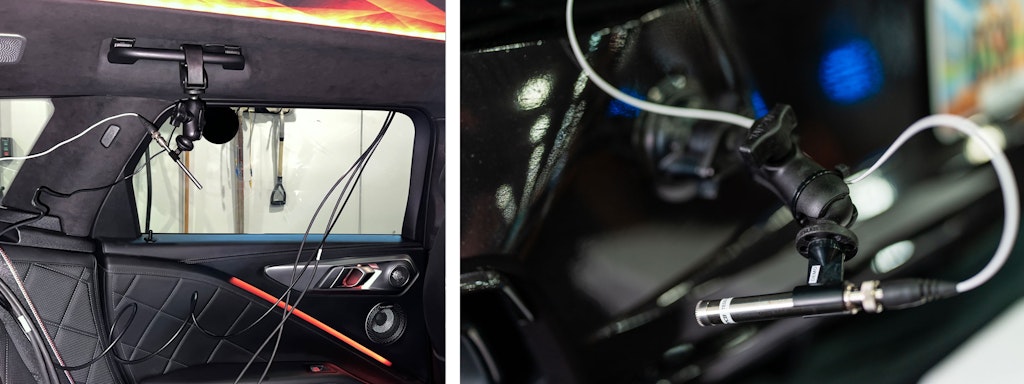
Learn about SIRIUS modular DAQ instruments.
SIRIUS® Modular
Modular Data Acquisition (DAQ) System
Occupant comfort testing
Occupant comfort data are derived from two primary data sources: weather stations and accelerometers.
The weather stations consist of a relative humidity sensor and a thermocouple. One of these weather stations is located in the cabin, while the other is positioned on the exterior of the vehicle. The goal of these weather stations is to determine the HVAC system's effectiveness in cooling, heating, and/or dehumidifying the cabin.
We use DewesoftX’s math suite to calculate the delta between interior and exterior conditions and determine if the HVAC system is performing as desired. Our thermocouples are connected to a KRYPTON 16xTH unit installed under the hood. 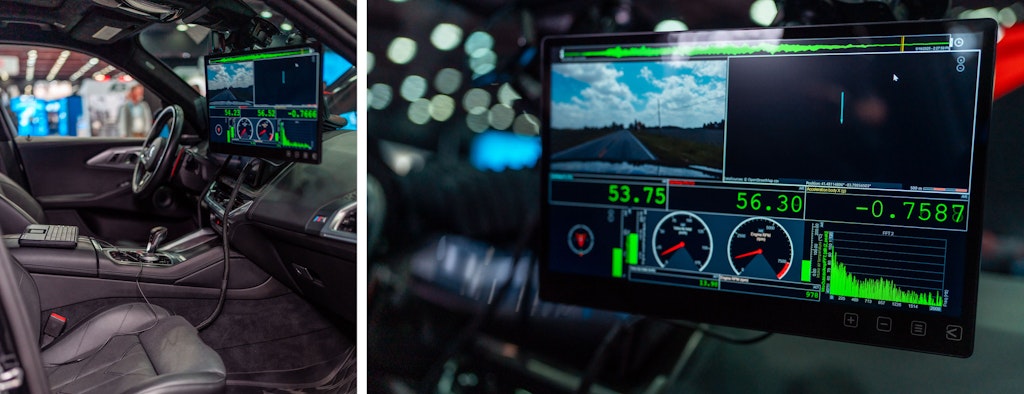
The IEPE accelerometers, mounted on the passenger seat and the rear control module, are connected to the SIRIUS 8xACC DAQ. They were chosen because they measure acceleration in only the desired direction and can detect higher peaks than the MEMS accelerometer.
Cameras are also aimed both inside the cabin to monitor the occupants' behavior and outside the cabin to monitor road conditions. This allows any anomalies, such as speed bumps or a seat belt adjustment, to be documented alongside the analog data.
The user interface is the Dewesoft DISP-15, a 15-inch touchscreen display mounted to the windshield. The DISP-15 allows the driver or a passenger to view data, start and stop collection, and make changes on the fly.
Power monitoring
Data from the hybrid power system is collected primarily from the CAN bus, including the motor's real-time high-voltage output, the battery charge level, and the battery voltage. Additional power measurements were collected using a simple voltage tap on the low-voltage (12 VDC) battery and a Dewesoft DS-CLAMP-200 current clamp to measure the power consumption of onboard accessories, such as the infotainment and HVAC systems.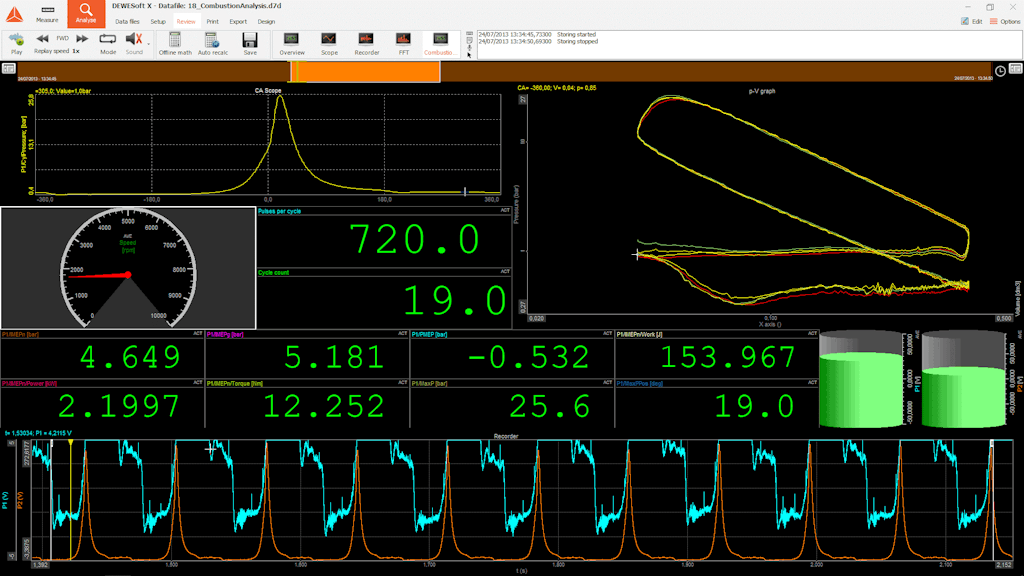
DAQ control and power
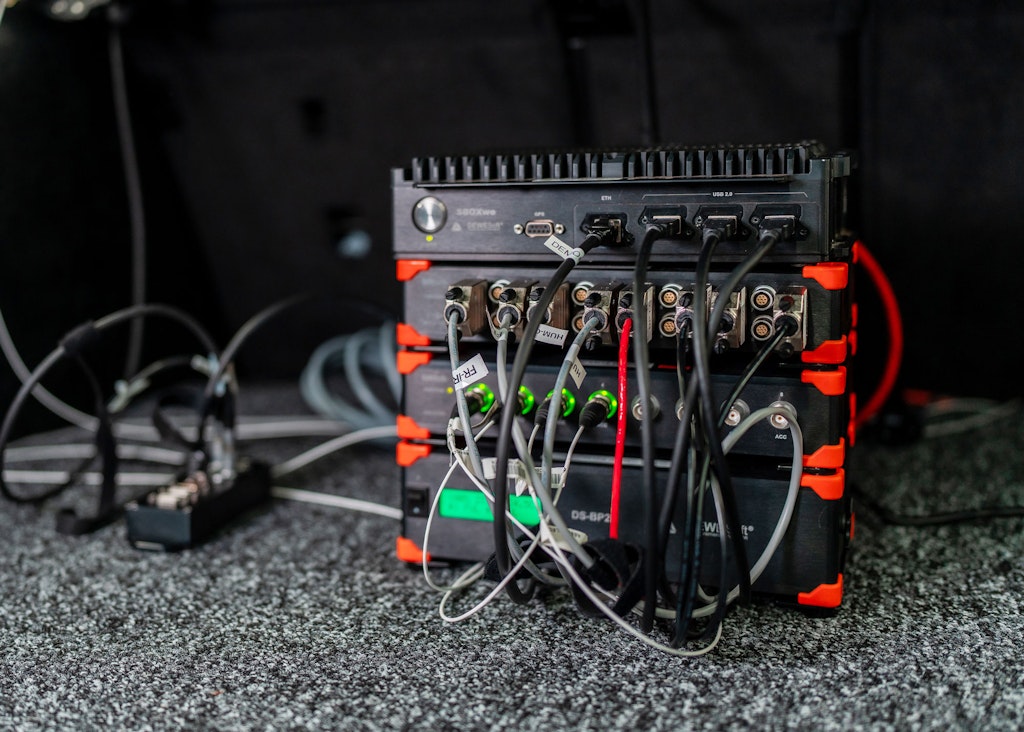
The Navion i2, SIRIUS 8xACC, SIRIUS 8xSTG, and KRYPTON 16xACC are all connected to a SIRIUS SBOX unit. A computing and data storage device, Dewesoft builds the SBOX in different levels of ruggedness. It attaches to a stack of SIRIUS modules.
The SIRIUS 8xACC provides eight IEPE inputs for accelerometers. Based on Dewesoft DualCore 24-bit technology, each input samples up to 200 kS/s with an exceptionally high dynamic range. The SIRIUS 8xSTG provides eight strain gage inputs that can handle every kind of bridge and strain gage sensor, as well as a host of other sensor types, using small DSI “smart adapters.” This module also includes 8 Dewesoft SuperCounters that can make angle-based measurements from counters, encoders, and tacho sensors. Each counter can alternatively be used as three discrete digital inputs.
The KRYPTON 8xACC also provides eight IEPE inputs, but this module is designed to withstand extreme temperatures, shock, and vibration. It is also sealed against dust and liquids to IP67 standards.
Installation
The installation of our measurement instruments was made with significant assistance from our Slovenian colleagues, who generously provided their time and expertise to help us integrate Dewesoft DAQ hardware with the BMW XM. The goal was to replicate a benchmarked vehicle, not a thoroughly tested vehicle, so all installations were done in a semi-permanent manner. All data acquisition system components and sensors are fully removable and do not require structural or cosmetic changes to implement.
The SIRIUS line simplifies setup with built-in ratchet strap slots and easy stacking capabilities, allowing the entire SIRIUS stack to be installed in the trunk in just minutes.
The Navion i2 simplifies the process by using either suction cups or magnets to attach to the vehicle, requiring only one wire to connect to a single breakout box that can be installed anywhere in the cabin.
Our ruggedized KRYPTON measurement module is easy to install in extreme environments, such as engine compartments. This reduces the number of cables needed to run from the engine to the PC from 12 thermocouple cables to just one EtherCAT cable.
Data collection
A collaborative effort between our Slovenian counterparts and US-based automotive application engineers outlined the data-collection process. Several test protocols were established:
- Acceleration and Braking
- Lateral Acceleration
- ADAS Testing with DewesoftX software and the Polygon plugin
These tests showcase the vehicle performance and critical capabilities of our DAQ in the vehicle. Interior and exterior cameras and microphones were used throughout to correlate the vehicles’ behavior with the resulting noise levels inside and outside.
Acceleration and braking
DewesoftX software replay of the USA show car running a short acceleration test.
Acceleration and braking data were collected by accelerating from 0 to 60 mph (0 to 96.56 kph) and then braking to a complete stop several times. Our brake test plugin calculated the acceleration, stopping distance, rate, and time. Speed, position, and acceleration were collected directly from the Navion i2.
Lateral acceleration
Instead of a skid pad, the gravel parking lot at the Dewesoft USA headquarters in Ohio was used to measure the vehicle's maximum lateral acceleration on a loose surface. This tested not only the tires but also the four-wheel steering and all-wheel-drive systems. Data was collected directly from the Navion i2 for body acceleration, slip angle, and position.
ADAS testing with polygon
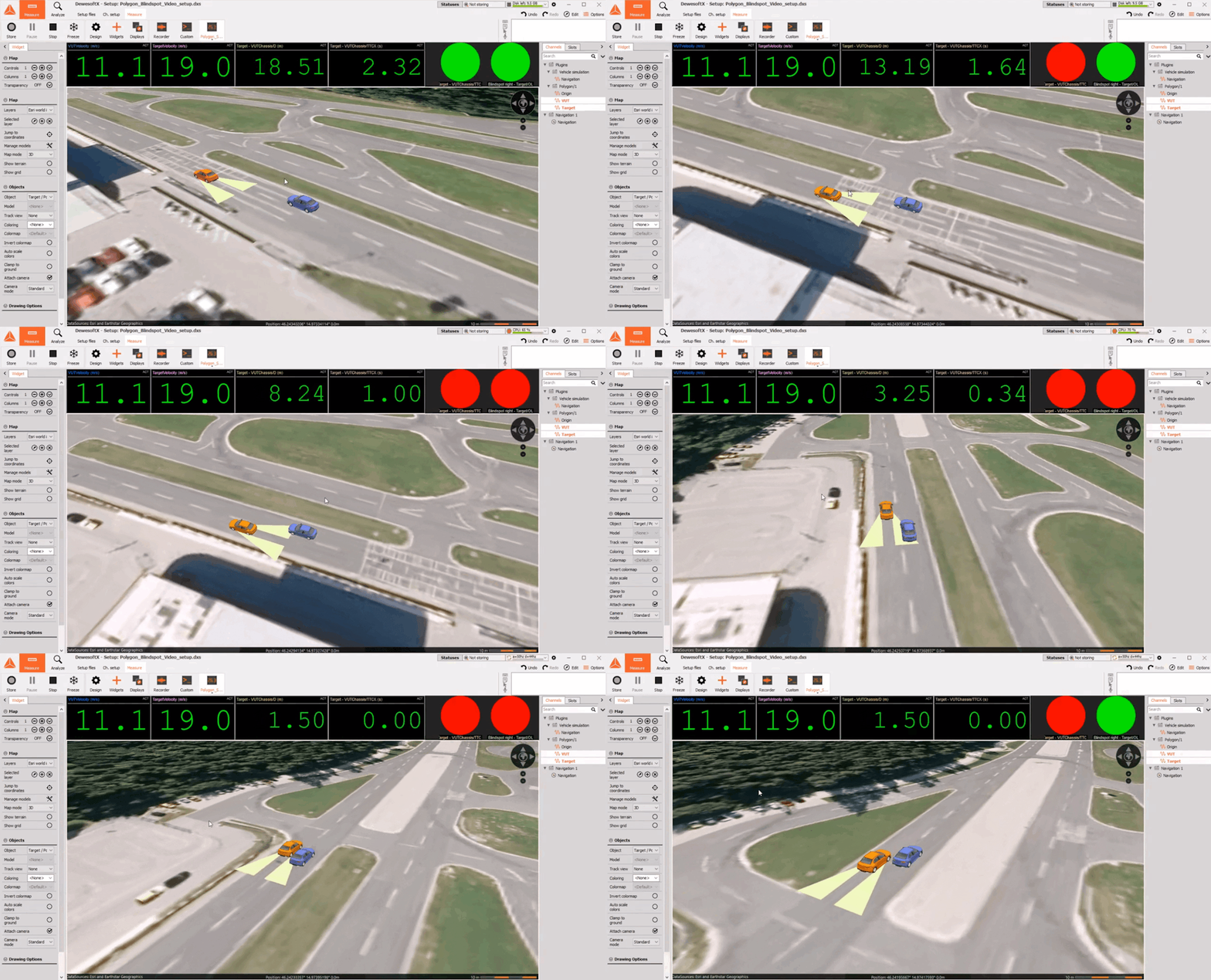
In more advanced scenarios, it can be configured to provide data on the effectiveness of the lane centering and lane departure warning systems, as well as the performance of the emergency braking system. Polygon provides real-time distance data between two or more objects and can send alerts if the distance is too close or too far. In addition to its powerful data acquisition, DewesoftX software provides a rich suite of post-processing tools.
Conclusion
The vehicle debuted at the Dewesoft USA Meet the Users Group event in May 2025, followed by its first public appearance at the Battery and Hybrid Show in Detroit in October 2025. Plans are in place to expand the USA show car's data acquisition capabilities, showcasing the extensive capabilities of Dewesoft’s hardware and software.
Dewesoft’s DAQ technology is ideal for testing all kinds of vehicles, including cars, trucks, motorcycles, and specialized vehicles made for the agriculture and construction industries. Still, due to their flexible nature and the interoperability of the entire product ecosystem, Dewesoft systems are also widely used in defense, aerospace, marine, energy, and industrial applications across dozens of industries worldwide.
VIR in foto: Dewesoft